BAGHDAD --
The leaders of Iraq's Christian minority Thursday called on the
country's beleaguered government to protect their community from attacks
by Al Qaeda-inspired Muslim extremists.
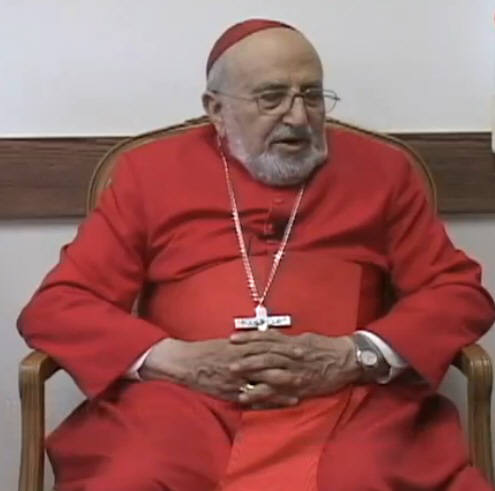
In a joint statement, Patriarch Mar Dinka IV of the Catholic Assyrian
Church of the East and the Chaldean Catholic Patriarch Emmanuel Delly of
Babylon said that
Baghdad's remaining Christians were facing persecution.
They blamed the so-called "Islamic State of Iraq," an alliance of
Islamist insurgent groups that serves as an
Al Qaeda front, for much of the violence.
"Christians in a number of Iraqi regions, especially those under the
control of the so-called Islamic State of
Iraq, have faced blackmail, kidnapping, and displacement," the
statement said.
The churchmen expressed surprise that Al Qaeda's influence has "reached
parts of Baghdad while the government has kept silent and not taken a
firm stance to stop their expansion."
Before the US invasion in March 2003 there were estimated to be around
800,000 Christians in Iraq, around 3 percent of the otherwise largely
Muslim population, living mainly in urban centers such as Baghdad.
Although there were some attacks on churches in the immediate aftermath
of the fall of
Saddam Hussein, Iraq's Christians were not especially targeted while
rival Sunni and Shiite Muslim factions went to war.
As a relatively wealthy community, however, many Christians fell prey to
kidnap and ransom gangs and many - probably more than half - of them
have fled the country or moved to the relative safety of Iraqi
Kurdistan.
Now there are reports that Salafist groups such as Al Qaeda,
fundamentalists who believe that Islam can be renewed by returning to
the values of the era of the Prophet Mohammed, are targeting Christians
on purely sectarian grounds.
In recent weeks a fatwa, or Muslim religious decree, has been issued by
extremists ordering Christians to flee Dura, a southern suburb of
Baghdad that is a hotbed of Sunni insurgent groups.
"We see that today we are being sent from our houses and forcibly
displaced from our homeland and alienated from our brothers with whom we
lived together," Delly complained this week in a sermon, according to
the Al Mutamer newspaper.
"I hereby send a plea in the name of all Christians to officials and to
all those whose power is in their hands to bring about peace, security
and stability among the sons of the homeland," he was quoted as saying.
In addition to calling on Prime Minister Nuri Al Maliki's government to
protect them, the patriarchs also urged the United Nations to intervene.
Iraq's Christian Minority Flees Violence
Half Of Nation's Christian Population May Have
Left After Increasing Incidents Of Attacks And Kidnappings
BAGHDAD, May 7, 2007,
http://www.cbsnews.com/stories/2007/05/07/iraq/main2766003_page2.shtml
(AP) Despite the chaos and sectarian
violence raging across Baghdad, Farouq Mansour felt relatively safe as a
Christian living in a multiethnic neighborhood in the capital.
Then, two months ago, al Qaeda gunmen kidnapped him and demanded that
his family convert to Islam or pay a $30,000 ransom. Two weeks later, he
paid up, was released and immediately fled to Syria, joining a mass
exodus of Iraq's increasingly threatened Christian minority.
"There is no future for us in Iraq," Mansour said.
Although Islamic extremists have targeted Iraqi Christians before,
bombing churches and threatening religious leaders, the latest attacks
have taken on a far more personal tone. Many Christians are being
expelled from their homes and forced to leave their possessions behind,
police, human rights groups and residents said.
The Christian community here, about 3 percent of the country's 26
million people, has little political or military clout to defend itself,
and some Islamic insurgents call Christians "crusaders" whose real
loyalty lies with U.S. troops.
Many churches are now nearly empty, with many of their faithful either
gone or too scared to attend. Only about 30 people attended this
Sunday's mass at St. Joseph's Catholic Church in the relatively safe
Baghdad neighborhood of Karradah, and only two dozen took communion in
the barren St. Mary's Church in the northern city of Kirkuk on Sunday.
As many as 50 percent of Iraq's Christians may already have left the
country, according to a report issued Wednesday by the U.S. Commission
on International Religious Freedom, a federal monitoring and advisory
group in Washington D.C.
"These groups face widespread violence from Sunni insurgents and foreign
jihadis, and they also suffer pervasive discrimination and
marginalization at the hands of the national government, regional
governments, and para-state militias," said the report.
Islamic extremists have also targeted liquor stores, hair salons and
other Christian-owned businesses, saying they violate Islam, the report
said.
"This is not the culture of Iraqis or the nature of Iraqis. We have
lived during centuries together in a respectful attitude and
friendship," said Luwis Zarco, the Catholic archbishop of Kirkuk.
In much of the Middle East, Christians are a largely tolerated minority
that have achieved a measure of business and professional success, but
they are sometimes viewed with suspicion by their Muslim neighbors.
In Saddam-era Iraq, the country's 800,000 Christians — many of them
Chaldean-Assyrians and Armenians, with small numbers of Roman Catholics
— were generally left alone. Many, such as Saddam Hussein's foreign
minister and deputy prime minister Tariq Aziz, reached the highest
levels of power.
But after U.S. forces toppled Saddam, insurgents launched a coordinated
bombing campaign in the summer of 2004 against Baghdad churches, sending
some Christians fleeing in fear.
A second wave of anti-Christian attacks hit last September after Pope
Benedict XVI made comments perceived to be anti-Islam. Church bombings
spiked and a priest in the northern city of Mosul was kidnapped and
later found beheaded.
In the recent violence, residents of the Baghdad neighborhood of Dora
said gunmen knocked on the doors of Christian families, demanding they
either pay jizya — a special tax traditionally levied on non-Muslims —
or leave. The jizya has not been imposed in Muslim nations in about 100
years.
One man, Arakan Admon, was wounded in a drive-by
shooting last week when his family ignored the threats, relatives said.
In response to the threats, about 70 percent of Dora's Christians have
fled, police said.
"The terrorists want to turn Dora into a base to attack other Baghdad
neighborhoods," said Christian lawmaker Younadam Kana. "Criminal gangs
made use of the situation and they started to kidnap Christians and
demand ransom. It is a coalition between terrorists and criminals."
The southern neighborhood is a Sunni insurgent stronghold that has seen
frequent U.S. shelling under a security crackdown against the sectarian
violence.
In the northern city of Mosul, men began knocking on doors last month,
demanding that Christian families pay a $3,000 tax that would be used to
fight the U.S.-led forces, local residents said. Some paid; others fled.
Mansour, a 63-year-old retiree, said that while many other Christians
left, he chose to stay in his Amariyah neighborhood in western Baghdad.
He was hoping that the Baghdad security plan, which U.S.-led forces
launched on Feb. 14, would improve the situation.
"But the opposite happened," he said.
Mansour was kidnapped March 11 by gunmen who identified themselves as al
Qaeda. After 15 days in captivity, his family paid the ransom and fled
the country, leaving their home and electric appliance store behind,
Mansour said in a telephone interview from Syria.
They said that if Mansour and his family did not convert, they would
have to pay $30,000. After 15 days in captivity, his family paid the
ransom, he said.
The next day, they fled the neighborhood, leaving their home and
electric appliance store behind. Hours later, an insurgent called
demanding Mansour bring back his car, he said. He returned, handed over
the keys, then left the country.
Days later, a group of insurgents knocked on his brother Mudhafar's
door, telling him to leave his house within 24 hours, because they don't
want Christians in the neighborhood, Mansour said. His family fled to
Syria as well, leaving all its possessions behind.
The local Hammurabi group, a Sunni human rights organization, harshly
criticized the attacks and demanded the government protect all Iraqis.
"These actions violate the values of Islam," the group said.
Iraqi
Christians under threat in Baghdad
By Ahmad Jumaa
Azzaman, May 3, 2007 (http://www.azzaman.com/english/index.asp?fname=news\2007-05-03\kurd.htm)
Iraqi Christians are fleeing their areas particularly in the restive
quarters of Baghdad despite the ongoing U.S. and Iraqi military
operations to bring stability to the city.
In the violent district of Doura, for example, all the remaining
Christians have received written warnings signed by armed groups either
to leave or covert to Islam.
Doura was a major Christian center with several monasteries, churches
and a major Chaldean Catholic seminary. They are all empty now with
monks, priests and congregations fearing to attend them.
A Christian member of parliament, Abdulahad Mansour, said to stay the
Christians are forced to pay a tax of 250,000 dinars for each member of
the family, an exorbitant sum which only few can afford in Iraq.
“I urge the government to put an end to these threats and practices and
find a solution to the suffering of Christians in Iraq,” said Mansour.
Another MP, Romeo Hakari, said large numbers of Christians have fled to
the Kurdish north or left the country for Syria or Jordan.
“Iraqi Christians have been subjected, following the collapse of the
former regime, and especially in Baghdad, to a real crisis for the first
time in their history. Many of them have been killed, many of them have
been kidnapped; their churches have been destroyed; and thousands made
homeless,” Hakari said.
 Subscribe
to our newsletter.
Subscribe
to our newsletter.
Copyright © Aram-Nahrin
Organisation